

You start January bursting with ideas, only to find your goals abandoned by March. The 12 Week Year isn’t another planner to buy; it’s a psychological hack to break the cycle of annualized thinking and the procrastination it creates.
We have all been there. The champagne pops, we write down ambitious resolutions, and we feel motivated. But somewhere around mid-February, life gets in the way. We fall behind. We tell ourselves, I have plenty of time to catch up later in the year. This is the trap of annualized thinking. When you view your goals through a 12-month lens, you lack urgency. A year is simply too long to sustain peak focus.
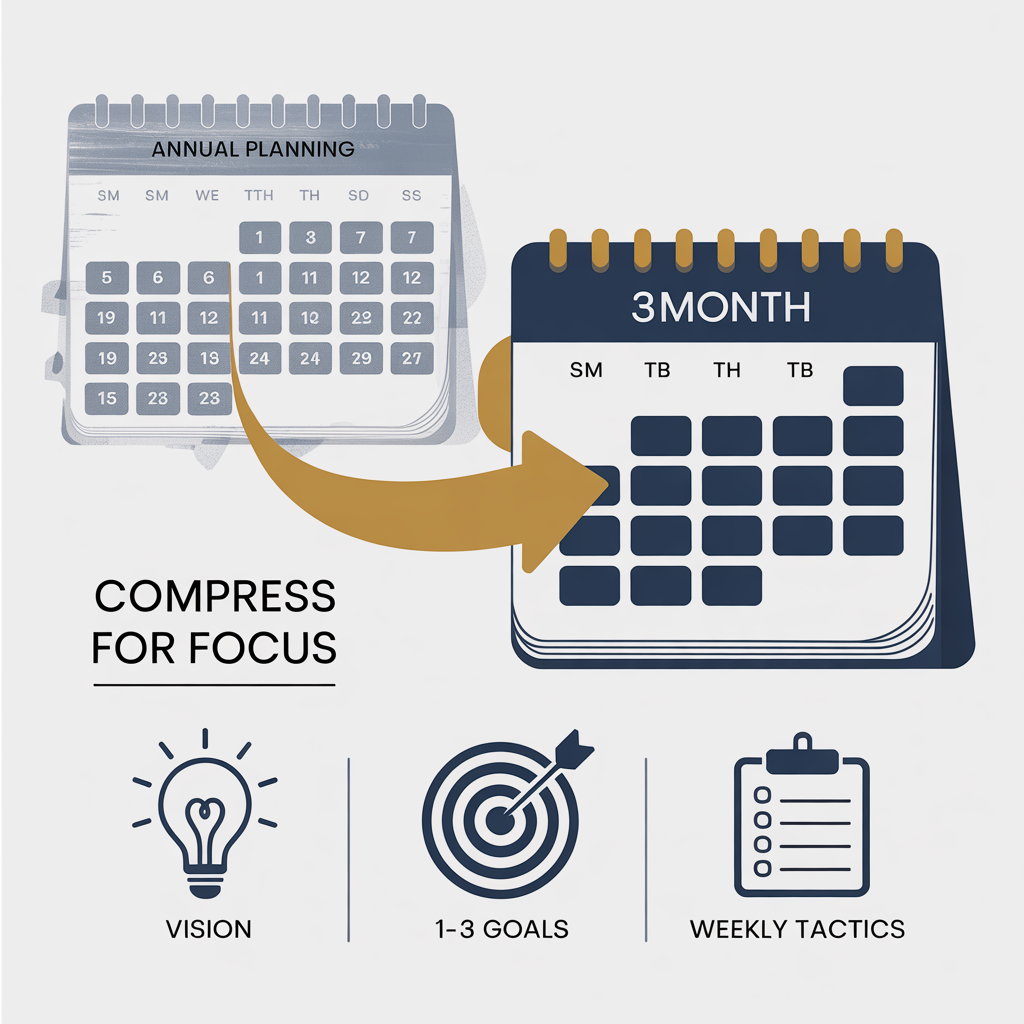
By compressing your timeline, the 12 Week Year forces you to treat every week as if it were a month, and every day as if it were a week. There is no catching up later. There is only now. This guide will walk you through the mindset shifts, the toolkit you need, and how to navigate the inevitable emotional slumps so you can finally execute your goals.
What Is the 12 Week Year?
The 12 Week Year is a productivity system that replaces the traditional 12-month planning cycle with a focused 12-week sprint. Created by Brian Moran and Michael Lennington, it’s built on a simple, powerful idea: when you have a full year to achieve a goal, you lack urgency and procrastinate. By compressing your timeline, you create immediate focus and accountability, treating each week as crucial. It’s not about doing more in less time, but about doing the right things with consistent, deliberate action.
Part 1: Beyond the Basics – The 3 Mindset Shifts for 12-Week Success
Before you start downloading 12 week year templates or searching for a quick summary, you need to understand why this system works. It is not about working harder; it is about changing how you view time.
From Yearly Pressure to Quarterly Freedom
The core philosophy of Brian Moran’s book is simple: stop thinking in years. When you have 365 days to do something, you naturally procrastinate. You think you have a buffer. By the time October hits, the end-of-year push begins, and productivity spikes.
The 12 Week Year takes that end-of-year intensity and applies it to a 12-week cycle. You aren’t sprinting for a whole year, which leads to burnout. You are sprinting for 12 weeks, then resting. This structure creates a healthy sense of urgency. If you have a bad week in a 12-week year, you can’t shrug it off. You have to correct course immediately.
From Planning to Execution
Most of us are professional planners and amateur executors. We love the feeling of buying a new journal or setting up a Notion dashboard. But as Moran points out, failure is rarely caused by not knowing what to do. It is caused by a lack of consistent action.
I remember my first attempt at this system. I spent two days designing a beautiful strategy and zero days doing the work. The system fails if you don’t track execution. The 12 Week Year focuses entirely on lead indicators, the actions you take daily, rather than lag indicators (the final result). You can’t control if you lose 10 pounds (lag), but you can control if you walk 30 minutes today (lead).
From Accountability to Ownership
We often view accountability as a scary concept, something that involves punishment if we fail. In this system, accountability is redefined as ownership. It is the willingness to account for your actions, regardless of the outcome.
When you look for a 12 week year review or summary online, you will see people praising the freedom of the system. That freedom comes from ownership. You stop blaming your boss, the economy, or your schedule. You own your execution score.
Part 2: Your Implementation Toolkit: Templates, Tech & Tactics
Understanding the theory is great, but let’s get into the weeds of how to actually run a 12 Week Year. You need a system that reduces friction.
Your Free 12 Week Year Planner PDF & How to Use It
You don’t need complex software to start. In fact, paper often works better because it is less distracting. We have developed a simple structure you can replicate.
If you are looking for a 12 week year planner PDF download, ensure it includes these three critical components:
- The Vision: A written statement of what your life looks like after you succeed.
- The Goals: 1 to 3 specific, measurable goals for the 12 weeks.
- The Weekly Plan: The specific tactics you will execute each week to hit those goals.
The 85% Rule:
Every week, you will score yourself. If you planned to do 10 tactics and you did 8, your score is 80%. The magic number is 85%. If you consistently hit 85% of your planned tactics, the data shows you will likely achieve your objective. This gamifies the process. You aren’t trying to win the championship every day; you are just trying to get an 85% on your scorecard.
Tech Stack Review: Apps to Automate Your System
While many users stick to the 12 week VKor physical journals, technology can help automate your tracking.
- The Achieve App: This is the official app associated with the program. It is designed specifically for this methodology, allowing you to track your weekly execution score automatically.
- Trello / Asana: If you prefer project management tools, you can create a Kanban board. Create columns for Weeks 1–12 and place your tactics as cards.
- Audible / E-Readers: If you struggle to sit down and read, listening to the 12 week year epub or audiobook during your commute is a great way to reinforce the mindset daily.
Finding Your Accountability Structure
You cannot do this alone. Or at least, it is much harder.
- Solo Scorekeeping: At a minimum, you must have a weekly meeting with yourself (usually Monday morning) to review your score.
- The WAM (Weekly Accountability Meeting): This is a 15-minute meeting with 2-3 other people. You do not solve problems here; you simply report your execution score and state your intentions for the next week.
- Online Communities: A quick search for 12 week year Reddit threads will reveal thousands of people looking for accountability partners. These internet strangers can be surprisingly effective at keeping you honest because they have no bias they only care about the data.
Part 3: Advanced Insights & Overcoming the Inevitable Slump
You will feel invincible in Week 1. You will feel tired in Week 5. This is normal, but you need a plan for it.
Navigating the Emotional Cycle of Change
Every new project follows an emotional curve. You start with Uninformed Optimism. Then, you hit Informed Pessimism when you realize how hard the work actually is. Eventually, you crash into the Valley of Despair.
This usually happens around Week 4 or 5. Most people quit here. They look for a 12 week year summary to see if there is a shortcut, or they try to find a pirated 12-week template year VK file, thinking the book has a secret chapter they missed. There is no secret. The only way out of the Valley of Despair is disciplined execution. If you know this slump is coming, you can prepare for it. When motivation fades, habit must take over.
Special Focus: The 12 Week Year for ADHD Brains
For those with ADHD, long-term goals are often invisible. The ADHD brain craves urgency and dopamine. This is why 12-week cycles are often touted as a game-changer for neurodiverse individuals.
The system provides the external scaffolding that executive function often fails to provide. By breaking a 12-week goal down into daily tactics, the barrier to entry is lowered. If you have ADHD, focus heavily on the Scorecard aspect. Seeing a physical score of 90% provides the immediate feedback loop that the ADHD brain finds rewarding.
Conclusion: Start Your Year Today
The calendar on the wall does not dictate when your year begins. You do not need to wait for January 1st. You can download a 12 week year template free of charge today, draft your vision tomorrow, and start your Year next Monday.
The beauty of this system is that it forgives failure quickly. If you blow a 12-week cycle, you haven’t wasted 12 months. You’ve only lost 12 weeks. You can shake it off, review what went wrong, and start a fresh year immediately.
Stop waiting for the perfect time. Grab a sheet of paper, map out your first 12 weeks, and take ownership of your execution.