
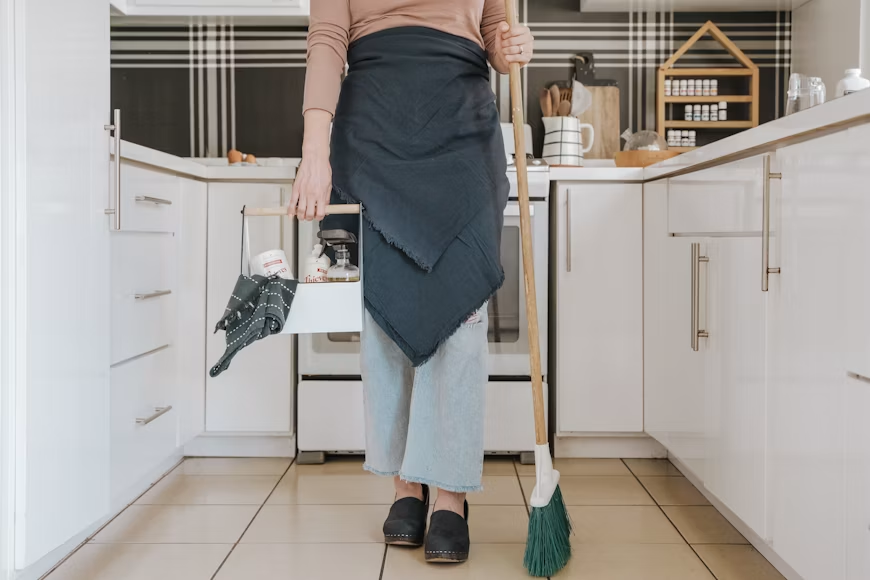
Yes, cleaning absolutely counts as a hobby. When approached intentionally, cleaning transforms from a mandatory chore into a voluntary, stress-relieving activity. For many women, organizing and tidying provide mental clarity, a creative outlet, and a genuine sense of personal fulfillment that meets all the standard criteria for a hobby.
Meet Sarah. She is a 34-year-old nurse and mother of two who spends her Sundays deep-cleaning her kitchen grout. To some, this sounds exhausting. To Sarah, it is the most relaxing part of her week. If you have ever wondered, Can I treat cleaning as a hobby? The answer is a resounding yes.
While society often frames housework as an unavoidable burden, a growing movement of women is reclaiming the scrub brush. They are finding genuine peace, creativity, and satisfaction in tidying their spaces. This article explores why cleaning and organizing have become popular pastimes, the psychology behind the satisfaction of a spotless room, and actionable strategies to make your own household routines more enjoyable.
What criteria make something a hobby?
When trying to figure out if cleaning is considered a hobby, we have to look at how we define our pastimes. Merriam-Webster defines a hobby as a pursuit outside one’s regular occupation engaged in especially for relaxation. So, does cleaning count as a hobby? Let us look at the standard criteria:
| Hobby Criteria | How Cleaning Fits |
| Voluntary engagement | Choosing to deep-clean or organize beyond basic necessity. |
| Provides relaxation | The repetitive motions of scrubbing or wiping can soothe the nervous system. |
| Develops skills | Learning new stain-removal techniques or organizing methods. |
| Yields personal satisfaction | Enjoying the visual reward of a sparkling, well-ordered space. |
The verdict is clear. If you clean for the mental benefits rather than just because you have to, cleaning completely qualifies as a legitimate hobby.
The psychology: Why does cleaning feel so good?
Many people ask if cleaning and organizing are a hobby or if it is just a coping mechanism. The data suggests it is a highly effective way to boost mental health. Whether cleaning is a hobby or not for you personally, science shows that tidying has tangible benefits for the human brain.
According to a 2019 study published in the Journal of Positive Psychology involving 1,582 women, engaging in mindful dishwashing led to a 23% reduction in stress and a significant increase in positive inspiration. The act of bringing order to a chaotic environment provides a powerful sense of control.
Health psychologist Dr. Kathleen Kendall-Tackett explains, Cleaning gives people a sense of mastery and control over their environment, which directly reduces anxiety. This is not just a niche phenomenon. A 2023 Statista survey revealed that 34% of adult women actively find cleaning and organizing to be relaxing activity. When life feels unpredictable, knowing exactly how to make your kitchen sink shine offers immediate, measurable satisfaction.
Real women who treat cleaning as a hobby
If you search for cleaning as a hobby on Reddit, you will find thousands of threads filled with women discussing their favorite vacuum attachments and organization hacks. Here are three real women who have embraced this mindset:
Jessica, 29 (The Anxiety Soother)
Jessica works in high-stakes corporate finance. When her anxiety spikes, she pulls out a toothbrush and cleans her baseboards. The hyper-focus required to scrub tiny corners pulls her mind away from spreadsheets and grounds her in the present moment.
Taylor, 41 (The Creative Organizer)
Taylor treats organizing her pantry like an art project. She curates matching glass jars, prints custom labels, and shares her aesthetic results on Instagram, where she has built a community of 200,000 followers. For Taylor, cleaning is a deeply creative pursuit.
Elena, 56 (The Budget-Conscious Homemaker)
Elena runs a popular local Facebook group dedicated to DIY cleaning solutions. She finds immense joy in mixing her own eco-friendly sprays using vinegar, citrus, and essential oils. Her hobby saves her family money while keeping her home pristine.
Which one of these approaches sounds the most like you?
Strategies: How to make cleaning fun for adults
If you want to know how to make cleaning fun for adults, the secret lies in changing your environment and your mindset. Here is how to make cleaning a hobby you actually look forward to, along with a few hobbies related to cleaning you can try.
- Declutter first: Take a page from Marie Kondo. You cannot effectively clean a space filled with items you do not need. Decluttering reduces visual noise and makes actual cleaning much faster.
- Upgrade your tools: Using a broken broom is frustrating. Investing in high-quality equipment, like the Wirecutter-recommended O-Cedar EasyWring microfiber spin mop, makes the physical act of cleaning far more satisfying.
- Temptation bundling: A famous 2014 study from the University of Pennsylvania showed that pairing a want with a should increases motivation. Only allow yourself to listen to your favorite true crime podcast while folding laundry.
- Create a cleaning uniform: Make it an event. Kandice, 38, jokingly wears a tavern wench dress and plays folk music while scrubbing her kitchen. Putting on specific cleaning clothes signals to your brain that it is time to work.
- Enhance the sensory experience: Light a premium candle before you start. Use surface sprays that smell like lavender or eucalyptus instead of harsh chemicals.
- Try the 5 Things Method: Licensed therapist KC Davis recommends tackling messy rooms by categorizing items into just five groups: trash, dishes, laundry, things with a place, and things without a place.
When Cleaning as a Hobby Becomes Something More
For some women, what starts as a Sunday deep-clean routine quietly grows into something bigger. Taylor built a 200,000-follower Instagram community around her pantry organization aesthetic. Elena turned her DIY cleaning spray experiments into a thriving local Facebook group. These are not unusual stories — they are what happens when you take something you genuinely enjoy and give it a little space to grow.
If you find yourself going down rabbit holes about grout cleaning techniques at midnight, testing natural cleaning products just to see which works best, or feeling a real sense of pride when you finish reorganizing a room — that is not an obsession. That is passion. And passion, directed intentionally, has a way of turning into something meaningful.
Some women have turned their love of cleaning and organizing into:
- Home organization consulting for busy families
- Cleaning product review blogs and YouTube channels
- Cleanfluencer social media accounts with real engaged audiences
- Local cleaning or decluttering services
You do not have to monetize it. But knowing that your hobby has real-world value beyond your own four walls makes it even more worth embracing.
The mindset shift: Embracing the joy of tidying
Cleaning as a hobby is not about having the most spotless home on the street or performing domesticity for anyone else. It is about choosing to find genuine pleasure in something you already do every week anyway.
The women who get the most from it are not the ones with the perfectly curated Instagram kitchens — they are the ones who stopped seeing the scrub brush as a symbol of obligation and started treating that hour of tidying as genuinely theirs. No notifications. No demands. Just visible, satisfying progress.
You are performing the same physical actions either way. The only difference is intention. So put on the podcast you have been saving, light the candle, and let yourself actually enjoy it. If a Sunday morning spent reorganizing your pantry leaves you feeling more like yourself than almost anything else — that is not a chore. That is exactly what a hobby is supposed to feel like.