
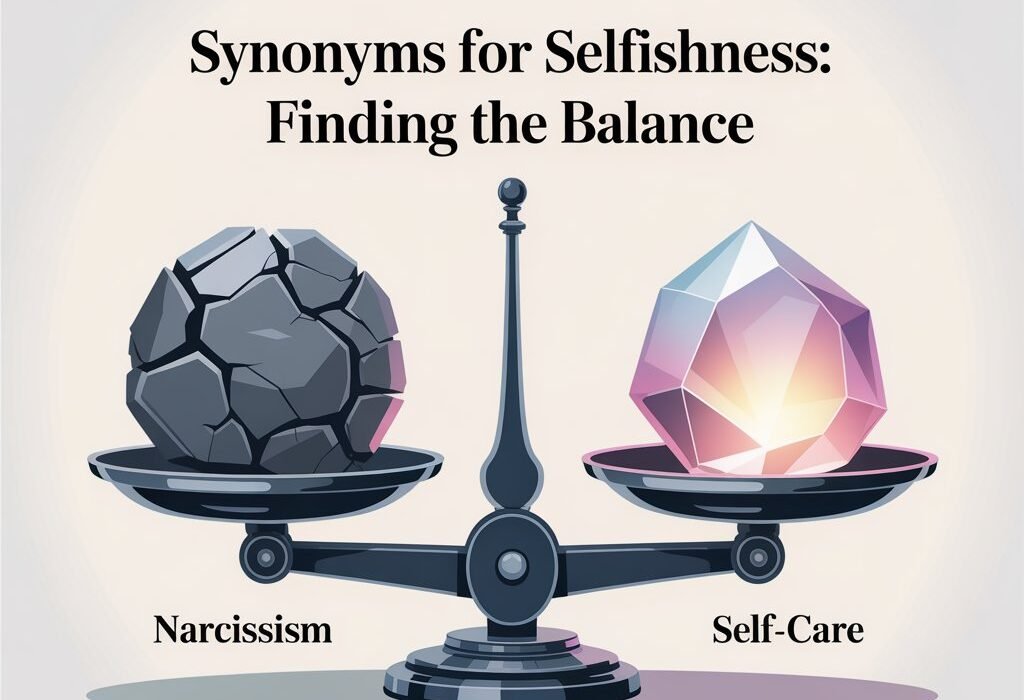
Searching for synonyms of selfishness reveals more than just a list of words; it uncovers a spectrum of human behavior. From toxic narcissism to neutral self-interest, understanding these nuances is key to better communication, self-awareness, and even setting healthy boundaries.
The word selfish carries an almost universally negative weight. It conjures images of someone who disregards the needs of others for their own gain. Yet, related concepts like self-care and self-interest are often framed as essential for a healthy life. So, where does putting yourself first transition from a healthy act of self-preservation into something harmful?
This guide will not only provide synonyms for selfishness but also explain their distinct shades of meaning. We will explore the selfishness spectrum, from everyday inconsideration to clinical personality traits, and help you determine when to use each word for maximum clarity and impact.
The Selfishness Spectrum
Not all selfishness is created equal. Instead of thinking of it as a single trait, it’s more useful to see it on a spectrum. Understanding this spectrum helps us use language more precisely and view behavior more empathetically.
Here’s a breakdown of selfish-related words, categorized by intensity and context.
| Intensity/Context | Key Synonyms & Nuances |
| Common & General | Self-centered, self-absorbed, inconsiderate, self-serving |
| Strong & Clinical | Egotistical, narcissistic, egocentric, solipsistic |
| Situational & Milder | Self-interest, self-involved, self-preservation, self-advocacy |
| Related to Greed | Avaricious, rapacious, acquisitive, grasping, materialistic |
Common & General: Everyday Self-Focus
These are the words we use most often to describe a lack of awareness of others in day-to-day situations.
- Self-centered: This describes someone who sees the world revolving around them. Their needs, desires, and opinions always come first. A self-centered person might dominate conversations or make plans without considering others.
- Self-absorbed: Similar to self-centered, a self-absorbed individual is excessively preoccupied with their own feelings, interests, and affairs. They may seem distant or uninterested in what is happening around them because their focus is turned inward.
- Inconsiderate: This is a more action-oriented term. An inconsiderate person acts without thinking about how their actions will affect others. Forgetting to hold a door or playing loud music late at night are classic examples of inconsiderate behavior.
- Self-serving: This adjective describes actions motivated purely by personal gain, often at the expense of fairness or group benefit. A self-serving decision benefits the decision-maker, regardless of the impact on others.
These behaviors are often learned and situational rather than being fixed personality traits. Everyone can have self-centered moments, but a consistent pattern can signal a deeper issue.
Strong & Clinical: When Self-Focus Becomes a Problem
These terms describe more extreme and ingrained forms of selfishness, some of which are studied in psychology.
- Egotistical: An egotistical person has an inflated sense of self-importance. They are boastful, arrogant, and constantly seek admiration. While it’s a common trait, it’s a step beyond simple self-centeredness.
- Egocentric: Often confused with egotistical, egocentrism is a cognitive limitation. An egocentric person is incapable of seeing a situation from another person’s perspective. It’s a normal stage in child development, but it can be a sign of immaturity in adults.
- Narcissistic: This is perhaps the most potent synonym for selfishness. In everyday language, a narcissistic person is vain and obsessed with their own image. In a clinical sense, it refers to traits associated with Narcissistic Personality Disorder (NPD), which includes a profound lack of empathy, a sense of entitlement, and a need for constant admiration. It’s important to use this clinical term carefully and avoid casually diagnosing others.
- Solipsistic: A more philosophical term, solipsism is the belief that only one’s own mind is sure to exist. A solipsistic person acts as if they are the only person who truly matters, viewing others as mere characters in their personal drama.
In my work with clients, I have often seen people paralyzed by the fear of being labeled selfish, when what they truly needed was to practice healthy self-interest to escape a toxic relationship or a draining job. This fear often stems from confusing necessary self-preservation with harmful narcissistic behavior.
Situational & Milder: A Positive Word for Selfish?
Sometimes, focusing on yourself is not only acceptable but necessary. These words describe the healthier, more neutral side of self-focus.
- Self-interest: This is the neutral act of pursuing what is best for oneself. In economics and politics, it’s seen as a primary motivator of human action. Healthy self-interest means you advocate for your needs, set boundaries, and make decisions that support your well-being without intending to harm others.
- Self-involved: While it can have negative connotations, being self-involved can simply mean being focused on your personal growth and projects. An artist absorbed in their work could be described as self-involved neutrally.
- Self-preservation: This is the fundamental instinct to protect oneself from harm. Setting boundaries, leaving a dangerous situation, or prioritizing your mental health are all acts of self-preservation. It is a vital and positive trait.
- Self-advocacy: This is the act of speaking up for your own needs and rights. In the workplace, at the doctor’s office, or in relationships, self-advocacy is crucial for ensuring you are treated with respect and fairness. It is a proactive and empowering form of self-focus.
Related to Greed: When Selfishness Wants More
This category of selfish synonyms is specifically about the desire for material wealth and possessions.
- Avaricious: This describes a ravenous, insatiable greed for wealth. An avaricious person will do almost anything to accumulate more money.
- Grasping: A grasping person is always trying to get more, especially money, and is often seen as ruthless in their pursuit.
- Acquisitive: This is a slightly more neutral term, describing someone skilled at acquiring money or possessions.
- Materialistic: A materialistic person places a high value on possessions and believes that wealth is the key to happiness.
Finding the Opposite: Antonyms for Selfishness
To fully understand a concept, it helps to know its opposite. The primary antonyms for selfishness highlight generosity and a focus on others.
- Altruistic: The direct opposite. An altruistic person shows selfless concern for the well-being of others.
- Selfless: Acting with little or no thought for one’s own benefit.
- Generous: Freely giving more of something, like money or time, than is strictly necessary or expected.
- Benevolent: Well-meaning and kindly; disposed to do good.
- Magnanimous: Generous or forgiving, especially toward a rival or someone less powerful than oneself.
A Practical Guide: When to Use Which Word
Choosing the right word makes your writing more precise and your communication more effective.
- Use self-centered or inconsiderate for everyday instances of someone failing to think of others.
- Use self-serving to describe an action motivated by personal benefit, like a politician’s vote.
- Use egotistical for someone obsessed with their own importance and who loves to boast.
- Use narcissistic carefully to describe a pattern of entitled, manipulative, and unempathetic behavior.
- Use self-interest or self-advocacy to describe a healthy and necessary focus on one’s own needs.
- Use avaricious or grasping when the selfishness is specifically about an insatiable desire for money.
The Power of Precise Language
Exploring the synonyms for selfishness is more than a vocabulary exercise. It is a tool for sharper writing, more empathetic communication, and more accurate self-reflection. When we understand the difference between being self-serving and practicing self-preservation, we can better analyze our own actions and the behavior of others.
The next time you reach for a word to describe someone putting themselves first, pause and consider the spectrum. Are they being inconsiderate, or are they advocating for their needs? Are their actions egotistical, or simply in their own self-interest? By choosing our words with intention, we can describe the world more clearly and navigate our relationships more wisely.
FAQs on Selfishness and Its Synonyms
Self-advocacy or healthy self-interest are the best positive terms. They describe the necessary act of prioritizing your well-being to function effectively, unlike selfishness which implies harming others.
Common synonyms include egoist, narcissist, or self-centered individual. For a humorous take, you might use terms like me-monster or hogger.
Egotistical generally describes boastful arrogance, while narcissistic implies a deeper psychological pattern of entitlement and lack of empathy, often associated with Narcissistic Personality Disorder (NPD).