

The list of things I want to say at work but can’t isn’t just a list; it’s a draining internal loop. It’s the meeting that replays in your head for hours, the email you draft and delete ten times, and the silent arguments you have in the shower. This cycle of frustration consumes your mental energy, leaving you exhausted and unable to focus on the work that actually matters.
What if you could disarm those thoughts without saying a word, turning mental frustration into detached observation? This isn’t about finding a new hobby or learning snappy comebacks. It’s about a psychological skill called cognitive reframing, a powerful method to manage your internal monologue at work and reclaim your mental peace. By learning to change the script inside your head, you can take back control, even when the situation feels out of your hands.
The High Cost of the Internal Scream
I once sat in a project update meeting where a colleague repeatedly took credit for a strategy my team had developed. I didn’t say a word. But the internal monologue at work was deafening. I didn’t just bite my tongue; I spent the next two hours locked in a mental argument, drafting and redrafting the perfect rebuttal. By the time I got back to my desk, I was mentally exhausted, and my actual work suffered. I’d won a dozen imaginary arguments but lost an afternoon of productivity.
This experience isn’t unique, and its effects are scientifically proven. The process of rumination that repetitive, negative thought loop activates the brain’s stress centers just as strongly as the actual event. Your body releases cortisol, your heart rate increases, and you remain in a state of high alert long after the trigger has passed. This constant mental strain is a direct path to burnout, anxiety, and disengagement. The silent scream doesn’t just stay silent; it echoes through your well-being.
The Reframing Method: Change the Channel in Your Brain
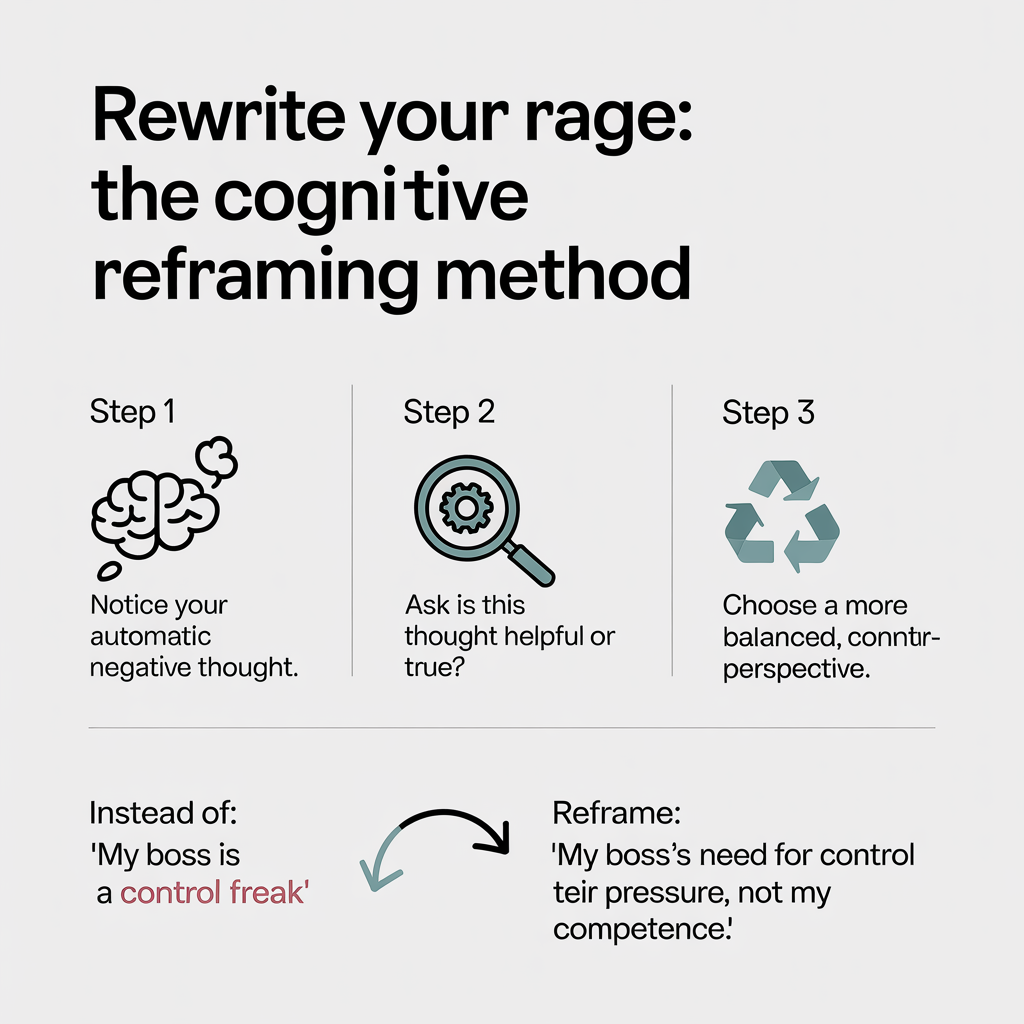
So, how do you stop the cycle? The answer lies in cognitive reframing, a technique rooted in cognitive-behavioral therapy (CBT). It’s not about suppressing your thoughts or pretending you’re not angry. Suppression often backfires, making the thoughts louder. Instead, reframing is about consciously changing your perspective on them. You step back, observe the thought, and choose a different, more empowering interpretation.
Think of it like changing the channel in your brain. The angry, frustrating show is playing on a loop. You have the remote. You can acknowledge the show is on, then deliberately switch to a different program, one that’s more productive and less stressful. The core technique involves identifying the automatic negative thought and consciously replacing it with a more balanced and constructive reframe. This shift interrupts the stress response and moves you from a state of emotional reaction to one of logical problem-solving.
Your Mental Reframing Guide
This is where the real work begins. Instead of just bottling up the things you want to say at work but can’t, you can transform them. Here is a guide to help you shift your internal monologue from frustration to focus.
Instead of thinking: My boss is a micromanaging control freak.
Your mind is focused on judgment, which fuels feelings of powerlessness and resentment.
Try reframing: My boss’s need for control is likely a reflection of their own anxiety or pressure, not a measure of my competence.
This reframe depersonalizes the behavior. It shifts your perspective from being a victim of their actions to an observer of their struggles. This doesn’t excuse their behavior, but it strips away the personal anger, allowing you to interact with them more strategically.
Instead of thinking, I am going to lose my mind if I get one more pointless task.
This thought is a pure expression of being overwhelmed and leads to a feeling of being trapped.
Try reframing: My reaction is a clear signal that my workload is at capacity. I need to plan how to communicate my current priorities and boundaries.
This turns raw emotion into an actionable insight. The frustration becomes data. It directs your energy toward finding a solution, like preparing for a conversation about your workload, rather than just stewing in resentment.
Instead of thinking, That colleague is an idiot.
This is a dead-end thought. It’s a judgment that offers no solution and only deepens your frustration.
Try reframing: We have fundamentally different working styles and communication methods. My goal is to find a functional interface, not to change them.
This reframe replaces judgment with a practical goal. You can’t change your colleague, but you can change how you interact with them. It becomes a puzzle to solve how to work effectively with this person, rather than a source of constant irritation.
Instead of thinking, This meeting is a massive waste of my time.
This thought breeds passivity and disengagement. You mentally check out, which makes the meeting feel even longer and more pointless.
Try reframing: What is one small piece of information I can extract from this that might be useful later? Or, what can I observe about the team dynamics?
This reframe shifts you from a passive victim to an active observer. It gives you a small, manageable mission. Even if the meeting is 95% useless, finding that 5% of value gives you a sense of agency and purpose.
Making It a Habit: The 3-Minute Mental Download
A mental reframing practice needs a simple, repeatable ritual to become a habit. For me, the only tool I use is the Notes app on my phone. When I feel that internal pressure building and I am about to explode, I find a quiet moment for myself. I open a new note and do a brain dump for three minutes. I write every furious, unprofessional, raw thought that comes to mind. No filter.
Then, I read it. I acknowledge the anger. At the bottom, I write one single Reframe for the most dominant thought. Finally, I delete the note. The physical act of externalizing the thought, consciously reframing it, and then deleting it is incredibly powerful. It breaks the rumination cycle and symbolizes a release. This simple action provides a concrete way to practice workplace mindfulness without needing a special app or a desk calendar full of snappy quotes.
When Your Thoughts Are a Red Flag
While cognitive reframing is an excellent tool for managing day-to-day frustrations, it’s also a diagnostic tool. If your internal monologue is consistently cynical, angry, or hopeless, it’s a major red flag for burnout or a toxic work environment.
These reframing techniques are for emotional maintenance, not for curing a fundamentally broken situation. Persistent negative thoughts are your mind’s way of telling you that something is deeply wrong. If you find yourself needing to reframe every interaction, every day, it might be a sign that the problem isn’t just your perspective, it’s the reality of your job. In that case, the most powerful reframe might be: These thoughts are a signal that it’s time to create an exit strategy.
Taking Control of Your Inner World
You may not control what happens in the office, the projects you’re assigned, or the personalities you have to deal with. But you can absolutely train yourself to control your internal world. Learning what to think when you are angry at work is a skill. Mastering the silent script of your thoughts is the ultimate form of power in a situation where you often feel powerless. It transforms you from a reactor to an actor, giving you the clarity and peace to thrive professionally.
What’s the most common negative thought loop you get stuck in at work? Share it below, and let’s practice reframing it together.